Rhodonite
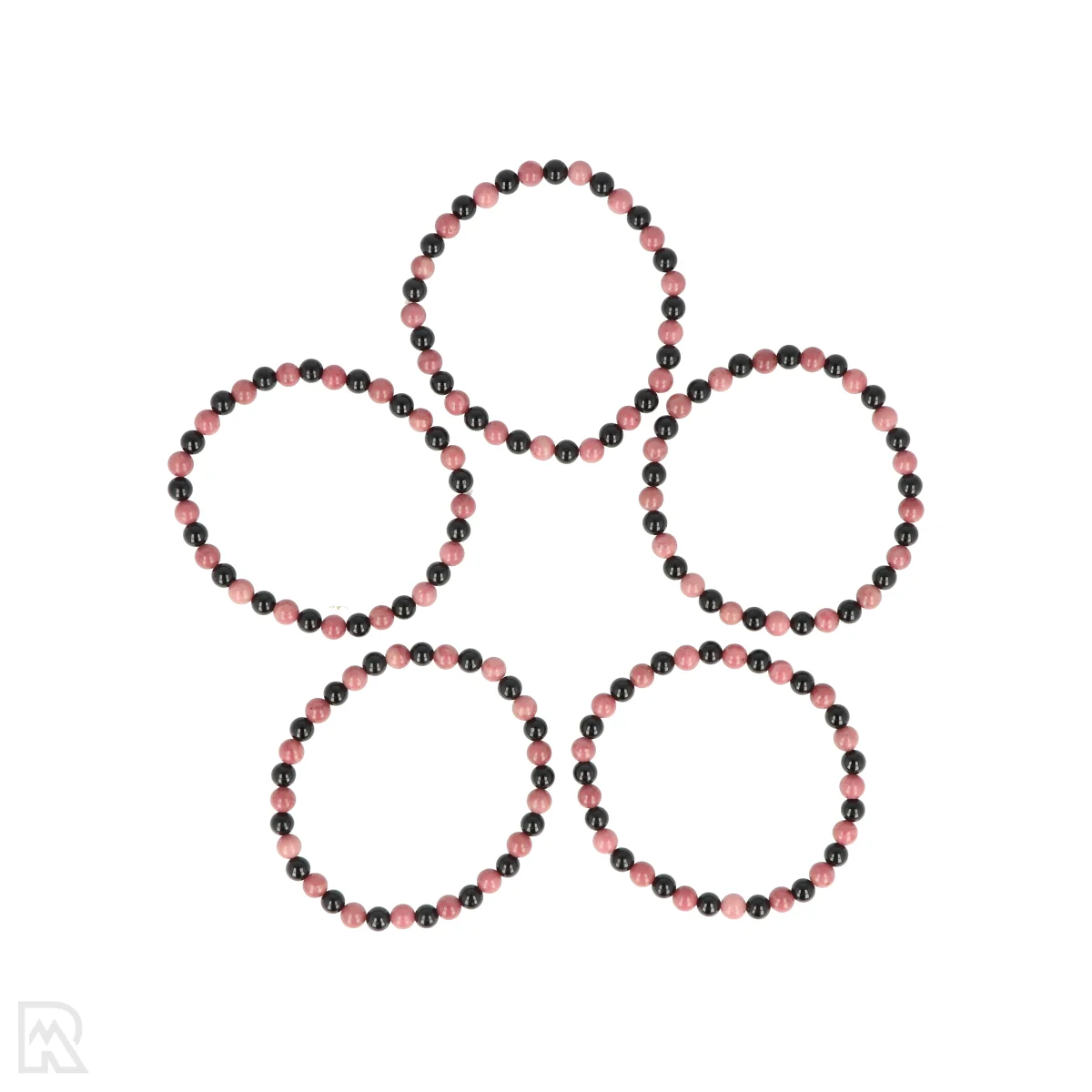
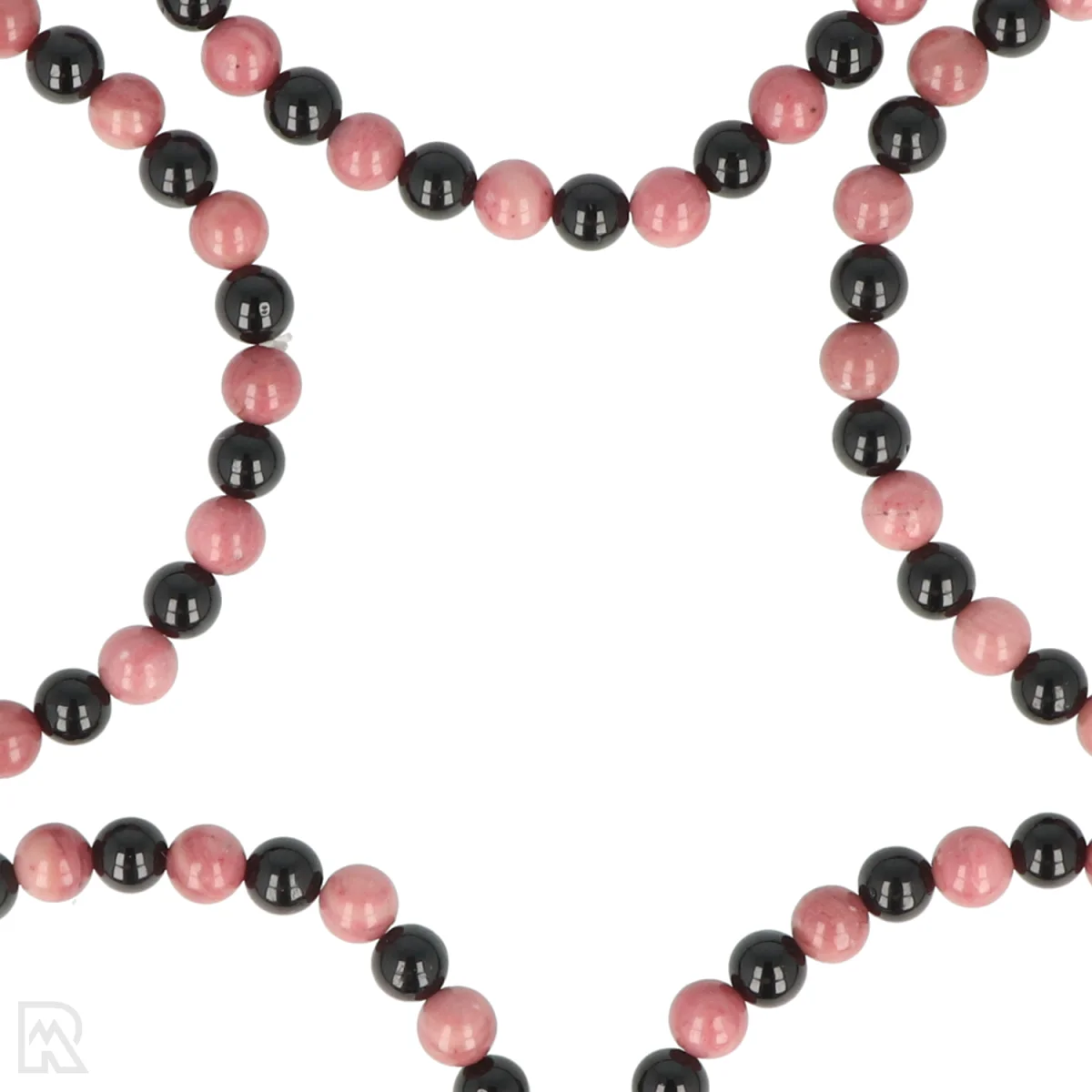
Rhodonite is a manganese silicate known for its pink to reddish colour, often featuring black veins of manganese oxide. The mineral usually forms in metamorphic rocks and is found worldwide. Its striking colour combination makes rhodonite popular for decorative purposes and in jewellery.
Major deposits include Russia, Australia, Sweden and Peru. Its chemical formula is MnSiO₃. Rhodonite has a hardness of 5.5 to 6.5 on the Mohs scale.
Popular varieties are pink rhodonite with black matrix and deep pink to reddish varieties from Russia and Madagascar, among others.
Sources:
Mindat.org, Gemdat.org, Wikipedia – Rhodonite
Tourmaline
Tourmaline is a group of borosilicate minerals with a complex chemical composition and a wide variety of colours. It occurs in virtually every colour of the rainbow, including pink, green, blue, black and multicoloured combinations. This diversity makes tourmaline one of the most popular gemstones in the jewellery world.
Tourmaline usually forms in pegmatites and metamorphic rocks. Major deposits include Brazil, Afghanistan, Mozambique, Nigeria and the United States. The chemical formula varies, but a general form is (Ca,K,Na)(Al,Fe,Li,Mg,Mn)₃(Al,Cr,Fe,V)₆(BO₃)₃(Si,Al,B)₆O₁₈(OH,F)₄. The hardness is between 7 and 7.5 on the Mohs scale.
Popular varieties include black tourmaline (schörl), pink tourmaline (rubellite), green tourmaline (verdelite) and watermelon tourmaline (pink interior, green rim).
Sources:
Mindat.org, Gemdat.org, Wikipedia – Tourmaline